
 on March 6, 2026
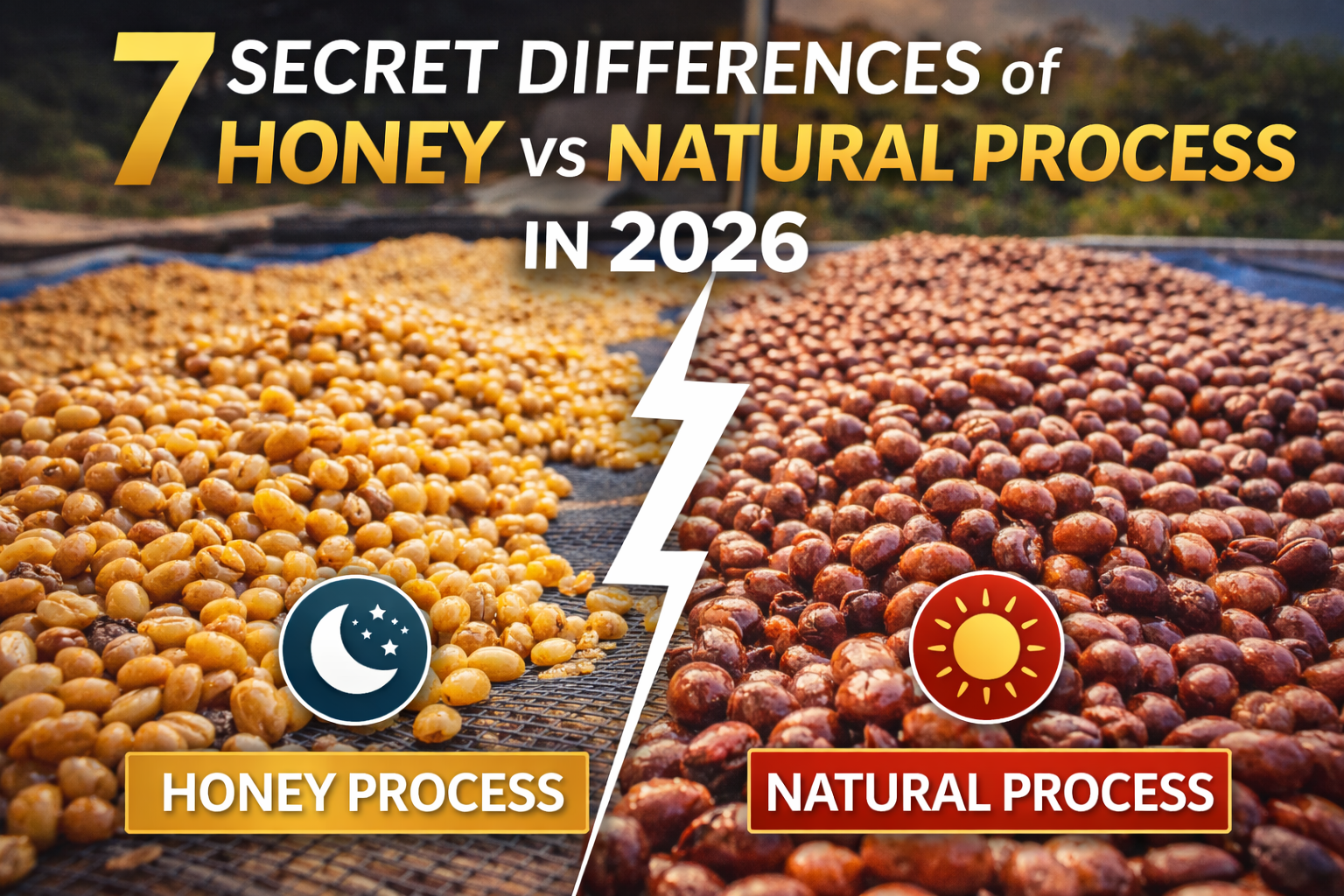 As the specialty coffee industry enters 2026, the demand for “Experimental Resilience” has shifted the conversation from basic processing to high-precision fermentation. For international importers and roastery owners, understanding the technical delta between Honey and Natural processes is no longer just about flavor—it is about supply chain stability, traceability data, and environmental compliance.
Here are the 7 secret technical differences defining the choice between Indonesian Honey and Natural lots in the 2026 market.
1. Mucilage Management and the “Fermentation Engine”
The fundamental difference lies in the biological “engine” of the process. In the Natural Process, the coffee cherry is dried whole, meaning the fermentation occurs within the intact skin (exocarp). In 2026, premium Indonesian naturals are often “Extended Naturals,” involving a preliminary anaerobic phase in hermetic tanks to develop intense berry notes.
Conversely, the Honey Process removes the skin but retains a specific percentage of mucilage (mesocarp). This exposed “honey” layer allows for a more targeted microbial intervention, often using specific yeasts like Saccharomyces cerevisiae to drive cleaner, more predictable acidity.
2. Water Activity vs. Moisture Content
While standard trade requires a moisture content of 10% to 12% for shelf stability, 2026 specialty buyers prioritize Water Activity
-
Naturals: Tend to have a more complex moisture migration path because the bean is insulated by the fruit. If not turned regularly on raised beds for 2–4 weeks, they risk “Primary Defects” like Full Black or Fungus.
-
Honeys: Because the skin is removed, moisture escapes faster and more evenly. Professional Indonesian exporters now target to ensure that expensive micro-lots do not age prematurely during transit to markets like Canada or the US.
3. The “Swavory” Flavor Equilibrium
The 2026 consumer palette is moving toward “Swavory” (Sweet and Savory) profiles.
-
Honey Process: Secretly excels in this category. Yellow and White Honey lots offer a refined, creamy sweetness with botanical infusions like cardamom and lavender.
-
Natural Process: Remains the king of “Functional Indulgence,” providing the bold, fruit-forward intensity (raspberry, tropical fruit) that Gen Z consumers demand in cold brew and nitro applications.
4. Environmental Footprint and Water Conservation
Sustainability in 2026 is a mandatory industry standard.
-
Natural Process: Is the most eco-friendly, requiring virtually zero water for processing.
-
Honey Process: Often marketed as “Semi-Washed,” it uses significantly less water than the traditional Fully Washed method because it skips the fermentation-washing tanks.
| Process | Water Usage | B2B Sustainability Rating |
| Natural | Zero | Ultra-High |
| Honey | Low | High |
| Washed | High | Medium |
5. EUDR and Traceability Mapping
With the European Union Deforestation Regulation (EUDR) taking full effect at the end of 2026, exporters must provide geolocation polygon data for every lot.
-
Naturals: Often sourced from diverse smallholders (micro-lots), making data mapping resource-intensive.
-
Honeys: Frequently processed at centralized “wet mills” or cooperatives, allowing for more streamlined digital origin storytelling and “Digital Handshakes” between producer and buyer.
6. Cupping Protocols: SCA vs. CVA
In 2025/2026, the industry officially transitioned from the traditional 100-point SCA score to the Coffee Value Assessment (CVA).
-
Natural Lots: Are being re-evaluated for their “Intensity of Attributes.” Buyers look for Naturals that hit the “Excellent” range without the funkiness associated with poor drying.
-
Honey Lots: Are prized for their “Cleanliness of Cup,” a metric that heavily influences their value in the premium espresso segment.
7. Commercial ROI and Market Scarcity
As specialty coffee becomes scarcer due to climate volatility, the price delta is widening.
-
Indonesian Black Honey: Often fetches prices times higher than commodity coffee when the mucilage is retained during a slow, dark drying process.
-
Experimental Naturals: Like Carbonic Maceration (CM) Naturals, are strategic assets for roasters looking to win competitions and differentiate their brand in a crowded market.
Which is the Strategic Choice for 2026?
For a global Indonesian green coffee exporter, the choice between Honey and Natural is dictated by the roaster’s goals. If the objective is a bold, “Instagrammable” flavor for a Gen Z audience, the Natural process is the leader. However, for roasters seeking a sophisticated, sustainable, and highly traceable B2B partner, the precision-engineered Honey process offers the best technical ROI.